Poultry Food Safety from Farm to Table: Why Layered Controls Matter
Safer poultry depends on managing food safety hazards—particularly biological hazards—through coordinated controls in production, processing, storage, preparation, and cooking.
Safer poultry depends on managing food safety hazards—particularly biological hazards—through coordinated controls in production, processing, storage, preparation, and cooking.
Poultry food safety is often reduced to a single question: Is a product free of Salmonella? That question matters, but it does not describe the full risk landscape. Biological hazards such as Salmonella and Campylobacter are central concerns, while chemical residues and environmental contaminants may also require attention under specific production conditions. The route from farm to table creates multiple opportunities for hazards to be introduced, transferred, reduced, or controlled.
This complexity explains why no single intervention can guarantee the safety of raw poultry. Effective programs use multiple barriers, with each participant in the supply chain responsible for controls appropriate to that stage. The practical goal is not to place the entire burden on farms, processing plants, retailers, or consumers. It is to prevent one weak point from undermining all the others.
Production Labels Do Not Function as Safety Guarantees
Terms such as organic, conventional, free-range, and pasture-based describe aspects of a production system. They do not, by themselves, establish that one product has a lower microbiological risk than another. Outdoor access may increase contact with soil, wild birds, fecal material, insects, and other environmental sources that are difficult to sanitize or exclude. A confined house offers different opportunities for environmental management, but confinement alone does not eliminate pathogen risk.
Comparisons among production systems therefore require careful interpretation. Research results can vary with bird genetics, growth rate, behavior, diet, housing, litter conditions, environmental exposure, sampling methods, and farm management. In one comparison discussed in the source material, birds of the same commercial type, sourced and fed alike, showed different Salmonella measurements when raised in conventional housing versus silvopasture. The result supports the importance of environmental exposure under those study conditions; it does not prove that every outdoor system will perform the same way.
Bird type may also influence exposure and measured contamination. Differences in activity, time spent in contact with litter or soil, growth rate, and development can coexist with housing effects. For that reason, a production claim should not replace an evaluation of the actual farm: site history, pest and wildlife pressure, litter management, sanitation options, water and feed controls, flock health practices, and processing conditions all matter.
On-Farm Control Begins with Exposure Management
At the farm level, pathogen reduction starts with limiting opportunities for introduction and spread. Biosecurity controls the movement of people, equipment, and materials into poultry areas. Rodent, insect, and wild-animal control reduces contact with potential biological vectors. Cleaning and sanitation lower contamination pressure where the housing system permits them, while adequate ventilation supports moisture control and broader litter and environmental management.
Vaccination can be part of a Salmonella control program. Feed- and water-based interventions may also contribute, depending on the specific product, target organism, production conditions, and evidence supporting their use. These measures are most useful as parts of a coordinated program. None should be interpreted as permission to relax biosecurity, sanitation, monitoring, or downstream processing controls.
Environmental history deserves particular attention in outdoor or alternative systems. Soil can reflect prior land use and may contain hazards unrelated to the current poultry operation. Understanding what occupied the site previously, how birds interact with the ground, and which contaminants are plausible is more informative than assuming that outdoor access is inherently safer or less safe.
Processing Adds Sequential Barriers
Processing plants apply controls at several points rather than relying on one final decontamination step. Scalding primarily facilitates feather removal, while system design and operating conditions also influence contamination and cross-contamination during this stage. Evisceration requires close control because intestinal contents can contaminate carcasses. Control of visible fecal contamination is an important component of hygienic processing, and carcass washing can apply water and approved antimicrobial interventions to external and internal surfaces.
Chilling is another critical control point. It lowers carcass temperature and, in water-chilling systems, can incorporate antimicrobial controls intended to reduce microbial loads. Additional sprays, washes, or dips may be used during cut-up and further processing. Emerging or complementary technologies—including high-pressure processing, ultraviolet light, and electrolyzed or ionized water—may offer value for specific products and operations, but their effectiveness depends on validated process conditions.
These interventions reduce risk; they do not make careless handling of raw product safe. Microbiological testing and regulatory verification provide important evidence about process control, but a passing result is not equivalent to sterility. Raw poultry should continue to be handled as a product that may contain pathogens.
The Consumer Is the Final Control Point
Many household failures occur through cross-contamination or poor temperature control. Washing raw chicken can spread contaminated droplets to the sink, countertops, utensils, and nearby foods. Avoiding that practice, washing hands with soap immediately after handling raw poultry or eggs, cleaning food-contact surfaces, and separating raw products from ready-to-eat foods reduce transfer opportunities.
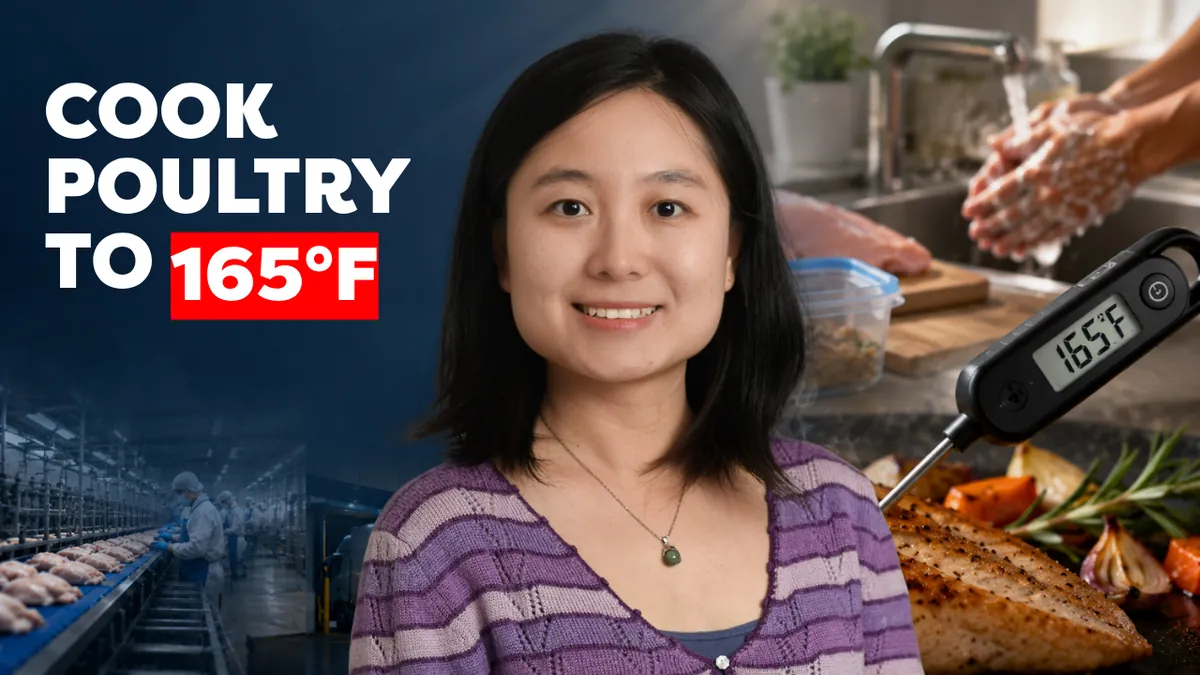
Cooking poultry to an internal temperature of 165°F (74°C) provides a critical lethality step. A food thermometer is more reliable than color, texture, or cooking time alone. Labels also require close attention because frozen breaded poultry products can look cooked even when they are raw or only partially cooked; visual appearance is not a dependable guide to preparation requirements.
Temperature control continues after purchase and after cooking. Raw poultry should not remain in a warm vehicle while other errands are completed. Cooked poultry and leftovers should be refrigerated promptly rather than left at room temperature for extended periods. Food can be recontaminated after cooking, and heat-resistant spores of bacteria such as Clostridium perfringens may survive cooking and subsequently germinate and grow if cooked food is improperly cooled or held at favorable temperatures.
Food Safety Is a Chain of Accountable Controls
The most useful way to evaluate poultry safety is to ask which hazards are plausible, where exposure or transfer can occur, and which validated control addresses each point. Production system labels cannot answer those questions on their own. Neither can a vaccine, antimicrobial rinse, inspection step, or consumer cooking instruction.
A strong program combines farm biosecurity and environmental management, hygienic processing, microbial reduction and chilling, cold-chain discipline, separation of raw and ready-to-eat foods, thorough cooking, and prompt refrigeration. Each barrier reduces a different opportunity for risk. Together, they create the farm-to-table system required to protect poultry products without depending on a silver bullet.
Learn more in The Poultry Podcast Show, Episode 210, “Dr. Lin Walker: Food Safety in Poultry”: listen to the episode.